What if your thyroid symptoms are not an isolated problem, but one signal from a body asking you to pay attention?
In this episode of Modern Thyroid & Wellness, McCall McPherson sits down with Kelly McKenna, CEO and Co-Founder of End Chronic Disease, for a powerful conversation about thyroid health, autoimmunity, environmental exposures, chronic stress, nutrition, and why preventing chronic disease requires looking far beyond a diagnosis.
Kelly shares her own journey from being diagnosed with celiac disease in high school to experiencing decades of autoimmune and chronic health challenges, including hypothyroidism and Hashimoto’s. A major turning point came in her early 30s when thyroid labs affected her plans to freeze her eggs. Instead of accepting her diagnosis as inevitable, Kelly became determined to understand what might be driving her health challenges.
Today, that personal experience fuels her work at End Chronic Disease, where she advocates for greater awareness, prevention-focused policies, healthier environments, and earlier education about the everyday factors that can shape long-term health.
Key Topics Covered
From Celiac Disease to a Deeper Search for Answers
Kelly’s health journey began long before her work in chronic disease advocacy.
In high school, she became extremely ill and was eventually diagnosed with celiac disease. Removing gluten helped, but it did not mark the end of her health challenges.
Over the following two decades, Kelly experienced multiple chronic and autoimmune conditions.
Then, in her early 30s, she began exploring egg freezing. Her laboratory testing revealed significant hypothyroidism, bringing her back to a thyroid issue she had previously experienced during college.
That moment became a catalyst.
Rather than assuming she had simply been unlucky, Kelly started asking what had changed and what might be driving the dysfunction. That curiosity eventually transformed not only her health but also the direction of her career.
The Overlooked Role of Childhood Stress
One of the most personal parts of the conversation focuses on Kelly’s childhood.
Kelly grew up in a loving and financially secure family, but her brother had significant disabilities and experienced dozens of unexplained seizures a day before receiving a diagnosis.
Kelly remembers constantly worrying about his safety, witnessing him being bullied, and carrying a persistent sense that something could go wrong.
It was only much later that she began connecting those experiences with a chronic stress response.
The conversation highlights an important distinction: childhood stress does not always look like the forms of trauma people traditionally imagine. Sometimes it is the prolonged experience of uncertainty, fear, or feeling unsafe that may continue shaping the nervous system long afterward.
How Much Influence Do Our Daily Choices Have?
Kelly describes the body’s biology as, in many ways, a reflection of daily life.
Food, sleep, stress, movement, relationships, environmental exposures, genetics, and access to appropriate care can all contribute to the larger health picture.
That does not mean every chronic disease is preventable or that people should be blamed for becoming sick.
Instead, Kelly sees prevention as an empowering opportunity to better understand the factors that can be changed while recognizing that many others are shaped by the systems and environments around us.
Environmental Exposures and Chronic Disease
A major part of the episode explores environmental health.
Kelly discusses paraquat, an herbicide that has received significant attention for its association with Parkinson’s disease. She also references research observing a higher rate of hypothyroidism among wives of agricultural workers who used paraquat, while carefully noting that an observed association does not prove the chemical directly caused those thyroid conditions.
The larger message is that environmental exposures deserve consideration when discussing chronic disease and thyroid health.
Kelly also points to differences in chemical regulation internationally and emphasizes that where people live, work, eat, and spend their time can influence their overall exposures.
Prevention Needs to Start in Childhood
Kelly believes preventing chronic disease cannot be limited to what adults do after they become sick.
Children spend more than a thousand hours at school each year, making schools an important part of the health environment.
The conversation explores:
Kelly explains that End Chronic Disease is particularly interested in K-12 prevention because habits established during childhood may continue into adulthood.
She also discusses disparities in school recess policies and why movement should be viewed as part of health rather than something that can simply be removed as punishment.
The Thyroid as a Barometer for the Whole Body
For Kelly, thyroid health eventually became much more than a laboratory result.
After being re-diagnosed with Hashimoto’s in her early 30s, she worked closely with an endocrinologist and began paying attention to how changes in her daily life correlated with her thyroid markers and symptoms.
They evaluated nutrients including:
Kelly also focused more intentionally on sleep and experimented with dietary changes.
As she made changes, she noticed something important: improvements were not limited to her thyroid numbers. Other symptoms involving her skin, digestion, fatigue, and overall health began changing as well.
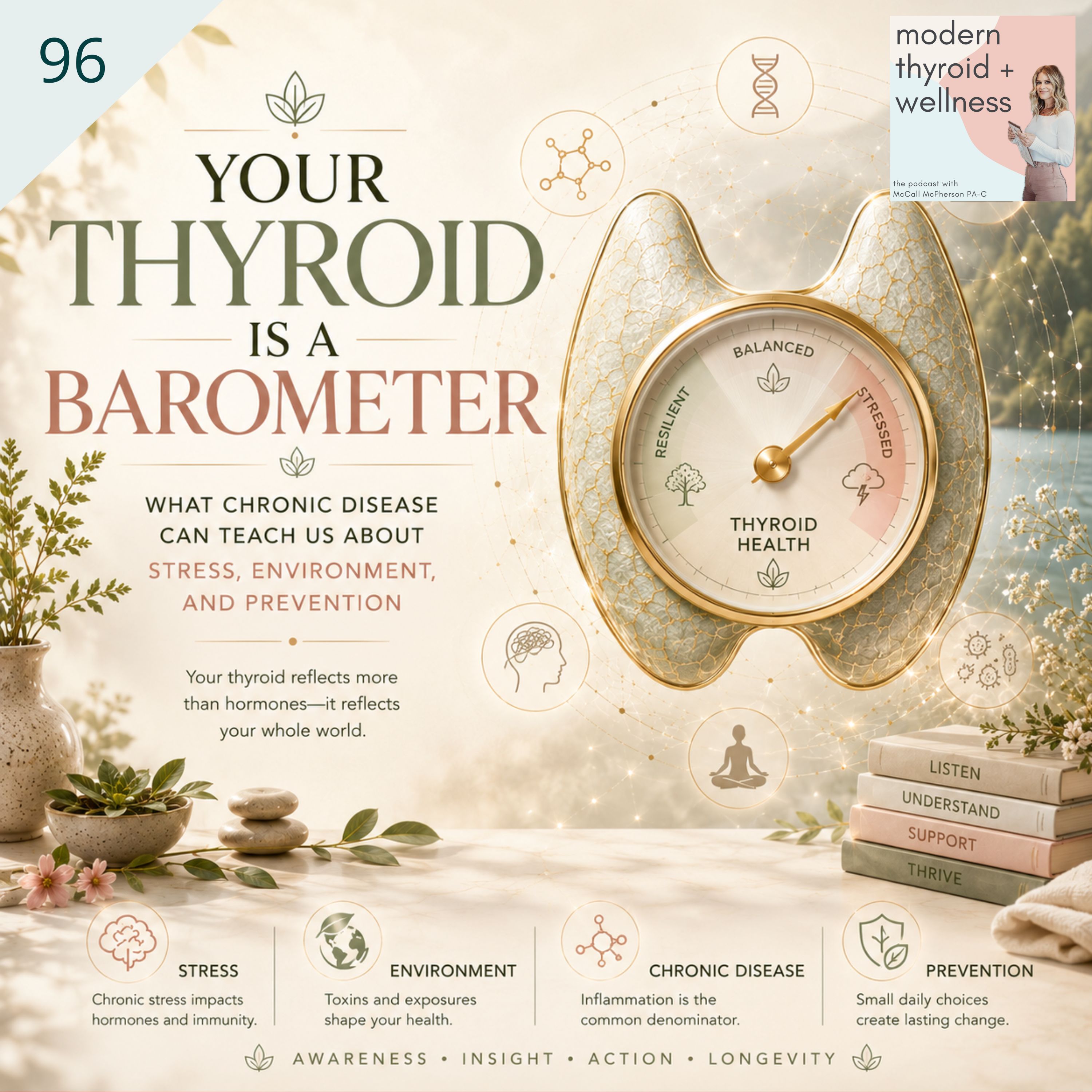
Today, Kelly describes her thyroid as a “barometer for my whole body.”
When she begins feeling slower, more tired, or notices familiar symptoms returning, she sees it as information that her body may need additional attention and recovery.
Learning to Listen Before Your Body Has to Scream
McCall and Kelly discuss how the body often provides warning signs before symptoms become debilitating.
The challenge is learning to recognize them.
Rather than viewing her thyroid only as something working against her, Kelly has learned to see those signals as useful information.
McCall connects this to the body’s built-in protective mechanisms and the importance of recognizing patterns early enough to adjust sleep, stress, nutrition, workload, or other factors before reaching complete exhaustion.
What Can You Do When You’re Already Exhausted?
Prevention advice can feel overwhelming when someone barely has enough energy to get through the day.
Kelly has experienced those periods herself.
Rather than suggesting a complicated wellness routine, she recommends returning to simple strategies that require less energy.
Her personal toolbox has included restorative yoga poses, putting her legs up the wall, prioritizing sleep, simplifying meals, eating less processed food, gentle walking, acupuncture, spending time with people she loves, and paying attention to emotional stressors that may be consuming energy.
She also emphasizes that a food considered healthy in general may not necessarily be what an individual body needs at a particular moment.
The goal is to listen, simplify, and gradually build a personal set of tools you know you can return to during difficult periods.
Relationships and Boundaries Affect Health Too
Health is not only about food and exercise.
Kelly encourages people to consider whether unresolved relationship stress, difficult boundaries, or emotionally draining situations may be consuming more energy than they realize.
Sometimes the source of exhaustion is obvious.
Sometimes it is not.
Becoming curious about what is happening emotionally, physically, environmentally, and socially can help people identify patterns they might otherwise overlook.
Bringing Prevention Into Public Policy
Kelly’s personal health journey ultimately led her away from her corporate career and into chronic disease advocacy.
Through End Chronic Disease, she is working to bring prevention into systems rather than placing the entire responsibility on individuals.
One major area of focus is education.
Kelly discusses the organization’s work supporting legislation in Texas that mandates nutrition education in K-12 public schools. She also describes California legislation that had passed the legislature at the time of recording and would add preventive health topics such as nutrition, stress, sleep, and environmental exposures to the public-school curriculum framework if signed by the governor.
Final Takeaway
Kelly’s message is ultimately one of curiosity rather than blame.
Chronic disease can be influenced by genetics, environment, childhood experiences, access to care, nutrition, stress, sleep, movement, and many factors people may not have been taught to recognize.
That is exactly why education matters.
Instead of seeing your body as the enemy, learn its patterns.
Notice the signals.
Build a toolbox you can return to when you are struggling.
And remember that creating healthier people also requires creating healthier environments, schools, communities, and systems.
For Kelly, prevention is not simply about avoiding disease. It is about giving people the knowledge and environments they need to make healthier choices earlier.
About Kelly McKenna
Kelly McKenna is the CEO and Co-Founder of End Chronic Disease, an organization working to increase awareness of chronic disease prevention and advocate for systemic changes that support healthier lives.
Her advocacy is deeply connected to her own experiences with celiac disease, autoimmunity, hypothyroidism, Hashimoto’s, chronic stress, and her long search to understand the root contributors to her health challenges.
Today, she combines her experience building organizations with her passion for prevention, education, environmental health, and policy change.
Resources & Connect with Kelly
🌐 End Chronic Disease Coalition
Learn More About End Chronic Disease
💼 Kelly McKenna on LinkedIn
Connect with Kelly on LinkedIn
📸 Kelly McKenna on Instagram
Follow @earth.to.kelly
Kelly also directs listeners to the End Chronic Disease website and its news section to follow the organization’s advocacy, journalism, op-eds, interviews, and ongoing prevention initiatives.
📖 Pre-Order Take Back Your Thyroid + Get a Free Bonus
Pre-order McCall McPherson’s new book, Take Back Your Thyroid, and choose one free bonus:
🎓 Thyroid Empowered Course, a $399 value
OR
🩺 $150 off a new patient visit at Modern Thyroid Clinic
Pre-Order & Claim Your Free Bonus
📲 Follow McCall McPherson & Modern Thyroid and Wellness
💻 Website: modernthyroidclinic.com
🐦 X / Twitter: @thyroidexpert
🌐 Host Website: mccallmcpherson.com
📺 YouTube: McCall McPherson Channel
📘 Facebook: McCall McPherson PAC
📸 Instagram: @mccallmcphersonpa